Posts tonen met het label Malamud. Alle posts tonen

vrijdag 23 maart 2012

NEN-normen en de wet

Ik was het al bijna vergeten, maar dankzij Carl Malamud moest ik er weer aan denken: de status van NEN-normen die in wet- en regelgeving genoemd worden.

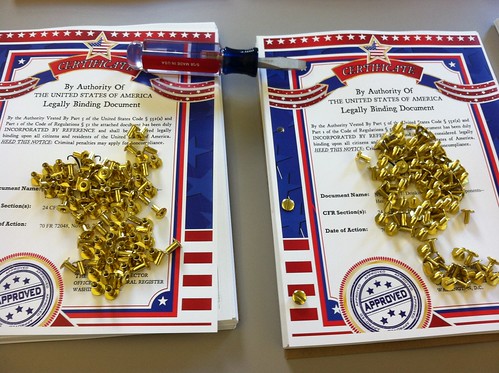
Malamud schrijft in Liberating America's secret: for pay laws over de rol van standaarden in Amerikaanse wetten. Public.Resource.org - de organisatie van Malamud - heeft voor $7,414.26 73 standaarden gekocht die deel uitmaken van federale wetten en hier 25 analoge kopieën van gemaakt en in grote dozen gestoptt:
We know from all the copyright warnings, terms of use, scary shrink wrap agreements, and other red-hot rhetoric that accompanies theses documents that the producers continue to believe that copies may not be made under any circumstances. Those of you familiar with copyright math know that statutory damages for unlawful replication of a document is $150,000 per infraction. So, even though we strongly believe that the documents are not entitled to copyright protection, and moreover that our limited print run is in any case definitely fair use, if a judge were to decide that what we did was breaking the law, 25 copies of 73 standards works out to $273,750,000 in potential liability. While whales may make bigger bets, we draw the line at $273 million.
De kopieën hebben ze daarna naar verschillende geadresseerden gestuurd: tien naar zogenaamde Standards Development Organizations, zeven naar overheidsinstellingen (waaronder NARA), de resterende acht zijn bedoeld voor publieke tentoonstelling, juridisch bewijs en enkele media.
De dozen voor de standaardontwikkelaars en de overheden gaan vergezeld van een packing slip (pdf, 9MB) waarin onder andere gevraagd wordt om een reactie voor 1 mei 2012.
Upon the close of the May 1 comment period, it is our intention to begin posting these 73 standards in HTML and begin the process of providing a unified, easy-to-use interface to all public safety standards in the Code of Federal Regulations. It is also our intention to continue this effort to include all standards specifically incorporated by reference in the 50 states. That the law must be available to citizens is a cardinal principle of law in countries such as India and the United Kingdom, and we will expand our efforts to include those jurisdictions as well.

Ik noemde NARA hierboven apart, omdat de vraag die daaraan gesteld wordt ook voor Nederland relevant kan zijn:
Does the National Archives and Records Administration systematically archive all American National Standards as approved by ANSI in order to "ensure continuing access to the essential documentation of the rights of American citizens and the actions of their government"? While ANSI standards incorporated by reference are only a subset of American National Standards, the full corpus deserves a place in the National Archives.
Hoe zit dat hier eigenlijk, met het archief van NEN en de vastgestelde normen?


Knooble vs Nederlandse Staat
In Nederland hadden we in 2010 een vergelijkbaar geval, toen bouwadviesbureau Knooble een civiele zaak aanspande tegen onder andere de Nederlandse Staat en eiste dat alle NEN-normen die in het Bouwbesluit genoemd worden, gratis beschikbaar moeten komen. In november 2010 deed het gerechtshof uitspraak in de hoger beroepszaak en oordeelde dat dat NEN-normen, door verwijzing ernaar in de bouwregelgeving, geen algemeen verbindende voorschriften worden en niet gratis hoeven te worden verstrekt. Knooble heeft daar geen genomen mee genomen en cassatie aangetekend bij de Hoge Raad. Hier kun je de voortgang daarvan volgen.
Eerstkomende mijlpaal is vandaag over een week, als de conclusie van de Procureur-Generaal gepland staat.

Gerelateerd
Amateur scanners aller landen verenigt u
Federal Scanning Commission, ook in Nederland?

Plaatje: Chicago Screws van Public.Resource.Org
donderdag 22 december 2011

Federal Scanning Commission, ook in Nederland?

We are not necessarily suggesting that the federal government immediately undertake an ambitious effort to scan the holdings of .gov, but if we ever hope to begin even a small piece of making available our past for use by our future, we should at least begin to scope out the size of the problem. We believe it would require a decade-long commitment to digitization to make our nation's cultural, scientific, educational, and historical resources available, but we can't even begin that discussion unless we know how big the problem is. Such an effort is indeed ambitious to contemplate, but we can only ask if we were able to put a man on the moon, why can't we launch the Library of Congress into cyberspace?
Nieuws van Karl Malamud, de man die de International Amateur Scanning League oprichtte. Hij pleit voor een "Federal Scanning Commission" die binnen een jaar de volgende vragen moet beantwoorden:
  1. What are the holdings of our national institutions? How many images, documents, videos, and other objects are there?
  2. How long would it take to digitize these materials?
  3. How much would it cost given current technology? Is there directed research or are there economies of scale that would bring those costs down?
  4. What is the strategy for digital preservation of these materials? How will we avoid digital obsolescence?
  5. What is the strategy for identifying restrictions on use of the material? How does one identify and safeguard materials that have copyright restrictions, contain personally identifiable information, or contain classified materials?
  6. What are the economic and non-economic benefits of such an effort?
    • What are the cost savings to government?
    • What are the economic benefits? Would this effort industries that build on top of scientific and technical information, spur innovation in the legal marketplace, or enable our creative industries to create more effectively?
    • What are the non-economic benefits? Will such an effort lead to better STEM and other educational efforts? Will it promote a more informed citizenry and better access to justice?
Kijk, dat zijn de betere ambities: binnen een jaar antwoorden op de meest cruciale vragen om binnen tien jaar alles gedigitaliseerd te hebben.

En weet je, dit past redelijk binnen de Archiefvisie van de staatssecretaris.
Wat als we een deel van die innovatiegelden nou eens aan een vergelijkbaar onderzoek besteden?

Gerelateerd
Amateur scanners aller landen verenigt u
Daar is hij dan, de #archiefvisie

Plaatje: Rogue Archivist van Justgrimes

zondag 4 juli 2010

Amateur scanners aller landen verenigt u

Afgelopen weekend legde Ferriero weer iets gedetailleerder uit wat hij verstaat onder "burger-archivarissen". Christian schreef er al over schreef en daarom zal ik er hier niet inhoudelijk op reageren.
Ik wil het hier hebben over de aanleiding van de blog van AOTUS. Hij was op 16 juni blijkbaar in Maryland op bezoek geweest bij de International Amateur Scanning League. Wat kunnen die Amerikanen toch mooie namen verzinnen!
De IASL is een onderdeel (of een spin-off, dat is me niet helemaal duidelijk) van Public.Resource.org van Carl Malamud. Ik weet niet hoe internationaal dit allemaal is, want eerlijk gezegd had ik hier allemaal nog nooit van gehoord. Maar interessant is het wel.
Die Malamud is wat in het Engels zo mooi heet een "public domain defender" en Public.Resource.Org is zijn stichting die "is dedicated to publishing and sharing public domain materials in the United States."

IASL
The International Amateur Scanning League is an experiment in crowd-sourced digitization to help government and other institutions make their archives more widely available. Volunteers will be given credit for their work in the on-line metadata, will receive cool tchotchkes, and will be eligible to display Public Domain Merit Badges upon completion of designated levels of service.
Een van de eerste projecten van de IASL is het dupliceren van overheidsfilms uit de archieven van het NARA en deze online zetten via FedFlix. Als ik het goed begrijp is het enige dat het NARA doet het beschikbaar stellen van de ruimte en hardware om de dvd's te kopiëren. De vrijwilligers van de League organiseren zelf wanneer ze bij het NARA aanwezig zullen zijn en houden zelf bij welke DVD's gereed zijn.

Tchotchkes
In de aankondiging van de oprichting staat verschillende keren dat de League "coole tchotchkes" beschikbaar stelt aan de vrijwilligers:
As part of the inaugural meeting of the IASL, a variety of very cool tchotchkes and support materials are being made available to volunteers, including stickers from CafePress, DVD transmittal forms from MOO, FedFlix return envelopes from ActionEnvelopes, posters from Zazzle, banners from Vistaprint, and brochures from QOOP. 
 Tchotchkes schijnt Yiddisch te zijn voor iets wat wij oneerbiedig prullaria zouden noemen, een beetje te vergelijken met de buttons en bekers van Archief 2.0. Opvallend vind ik dan weer dat ze gekoppeld worden aan bepaalde prestaties.

Internationaal
Interessant allemaal, maar hoe internationaal is dit nu eigenlijk? Is er buiten de Verenigde Staten al ergens een filiaal geopend? En lopen we in Nederland niet op zijn minst een paar passen voor, met projecten als Geboren in 1809, de Charterbank en het nieuwe project in Amsterdam?