Posts tonen met het label mediawijsheid. Alle posts tonen

woensdag 23 januari 2013

De overleden vriendin die niet bestond

Het kan altijd gekker.
In september 2012 werd Manti Te'o, de Mormoonse linebacker van het American footballteam van Notre Dame, getroffen door het noodlot. Binnen zes uur stierf zowel zijn oma Annette Santiago als zijn vriendin Lennay Kekua.
Deadspin schrijft:
Kekua, 22 years old, had been in a serious car accident in California, and then had been diagnosed with leukemia. [Sports Illustrated]'s Pete Thamel described how Te'o would phone her in her hospital room and stay on the line with her as he slept through the night. "Her relatives told him that at her lowest points, as she fought to emerge from a coma, her breathing rate would increase at the sound of his voice," Thamel wrote.
Upon receiving the news of the two deaths, Te'o went out and led the Fighting Irish to a 20-3 upset of Michigan State, racking up 12 tackles. It was heartbreaking and inspirational. Te'o would appear on ESPN's College GameDay to talk about the letters Kekua had written him during her illness.
Een typisch Amerikaans verhaal, van ontbering, boven jezelf uitstijgen en zo.
Maar, zo gaat Deadspin verder, er is niets van waar!
Manti Te'o did lose his grandmother this past fall. Annette Santiago died on Sept. 11, 2012, at the age of 72, according to Social Security Administration records in Nexis. But there is no SSA record there of the death of Lennay Marie Kekua, that day or any other. Her passing, recounted so many times in the national media, produces no obituary or funeral announcement in Nexis, and no mention in the Stanford student newspaper.
Nor is there any report of a severe auto accident involving a Lennay Kekua. Background checks turn up nothing. The Stanford registrar's office has no record that a Lennay Kekua ever enrolled. There is no record of her birth in the news. Outside of a few Twitter and Instagram accounts, there's no online evidence that Lennay Kekua ever existed.
The photographs identified as Kekua—in online tributes and on TV news reports—are pictures from the social-media accounts of a 22-year-old California woman who is not named Lennay Kekua. She is not a Stanford graduate; she has not been in a severe car accident; and she does not have leukemia. And she has never met Manti Te'o.
Daarna reconstrueert de website welke (sport)media de afgelopen drie jaar iets schreven over Kekua en haar relatie met Te'o. In het begin zijn het vooral Sports Illustrated en de South Bend Tribune die over het meisje schrijven. Maar na haar "dood" gaan alle grote media voluit: ESPN, New York Post, LA Times, CBS, Associated Press. CBS toonde op een gegeven moment zelfs deze foto van Kekua:

Maar zegt Deadspin
This week, we got in touch with a woman living in Torrance, Calif. We'll call her Reba, to protect her identity. She was initially confused, then horrified to find that she had become the face of a dead woman. "That picture," she told us over the phone, "is a picture of me from my Facebook account."
En het wordt nog gekker, want blijkbaar communiceerden Kekua en Te'o ook via twitter met elkaar:
Lennay Kekua's Twitter name was @lovalovaloveYOU from 2011 until April 2012, @LennayKay from April until September 2012, and has been @LoveMSMK ever since. Their interactions, by and large, consisted of mild flirting. By January 2012, they were a "couple," and Te'o sprinkled #LMK (for Lennay Marie Kekua) throughout his Twitter timeline in 2012.
As for what Kekua was tweeting, we have only bits and pieces. Her Twitter was private during most of this time, though various Google caches reveal her ever-changing series of avatars and a handful of Twitpics.
All of those photographs—with one important exception—came from the private Facebook and Instagram accounts of Reba, whom we found after an exhaustive related-images search of each of Lennay's images (most of which had been modified in some way to prevent reverse image searching).
En we zijn er nog niet, want een van de foto's die Kekua op haar Twitter-profiel gebruikte (en die hier helemaal bovenaan staat), kwam niet van het Facebook-profiel van die "Reba". Dat was een foto die ze op verzoek van een oud-schoolgenoot had gemaakt en naar hem had gemaild. De naam van deze man: Ronaiah Tuiasosopo.
Om een nog langer verhaal kort te maken: Tuiasosopo was een vried van Te'o en creëerde Kekua.
De vraag is nu nog: wist Te'o dit?
In een verklaring zegt hij zelf van niet:
This is incredibly embarrassing to talk about, but over an extended period of time, I developed an emotional relationship with a woman I met online. We maintained what I thought to be an authentic relationship by communicating frequently online and on the phone, and I grew to care deeply about her. To realize that I was the victim of what was apparently someone's sick joke and constant lies was, and is, painful and humiliating. It further pains me that the grief I felt and the sympathies expressed to me at the time of my grandmother's death in September were in any way deepened by what I believed to be another significant loss in my life.
Maar niet iedereeen is hiervan overtuigd. Hij heeft in ieder geval de schijn tegen.

Gerelateerd
Drie keer gestorven, vijf jaar cel
zaterdag 21 januari 2012

Wachtwoord delen als teken van liefde


In Amerika (waar anders zou ik bijna schrijven) schijnt het onder tieners al een tijdje gebruikelijk te zijn om wachtwoorden uit te wisselen als een teken van liefde.
The digital era has given rise to a more intimate custom. It has become fashionable for young people to express their affectionfor each other by sharing their passwords to e-mail, Facebook and other accounts. Boyfriends and girlfriends sometimes even create identical passwords, and let each other read their private e-mails and texts.
Sommigen, en dat is toch wel vertederend, spreken samen een wachtwoord af, waar hun liefde uit blijkt. Hij ILoveAly, zij ILoveKevin. Beetje korte wachtwoorden, maar wel süß...
Wat ik het opvallendste in het hele artikel vind, is de vergelijking met sex die door verschillende "deskundigen" gemaakt wordt. Rosalynd Wiseman, auteur van het boek Queen Bees and Wannabes zegt:
Sharing passwords, she noted, feels forbidden because it is generally discouraged by adults and involves vulnerability. And there is pressure in many teenage relationships to share passwords, just as there is to have sex.
En Patti Cole, moeder van een zestien-jarig meisje en kinderpsycholoog denkt:
young people are sometimes drawn to such behavior as they might be toward sex, in part because parents and others warn them against doing so. "What worries me is we haven’t done a very good job at stopping kids from having sex,” she said. “So I’m not real confident about how much we can change this behavior.”
Op Gizmodo heeft Sam Biddle zelfs een soort handleiding (niet per sé voor tieners trouwens) gemaakt met  welke wachtwoorden je wel kunt (of zelfs moet) delen en welke niet:
  • Netflix - Ja zeker
  • e-mail - Never nooit
  • Facebook - Never nooit
  • AIM - Never nooit
  • Telefoon - ja, doe maar
  • Computer - ja doe maar [maar - voeg ik daar aan toe - als je vriendje Joran van der S. heet, kun je het wachtwoord beter niet vragen...]
Mijn kinderen zijn nog niet zo oud, dus ik heb hier nog geen ervaring mee, maar komt dit ook in Nederland voor?
Is het ook hier een probleem?
Moet er iets gebeuren?
Of is dit een typisch Amerikaans probleem?

(Overigens, mijn vrouw en ik weten ook de wachtwoorden van elkaars e-mailaccounts...)

Gerelateerd
Informatiebeveiliging door bewustwording? Ja natuurlijk!
Monumentale accounts

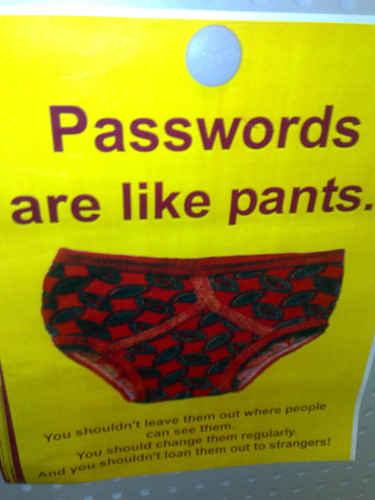
Foto: Passwords are like pants van Richard Parmiter

dinsdag 2 augustus 2011

"Digital natives" bestaan niet, volgens Rushkoff


Als je een uurtje over hebt, is dit een heel interessante lezing van Rushkoff bij Google: Program or Be Programmed: Ten Commands for a Digital Age. Over mediawijsheid, jeugd, digital immigrants en digital natives. 
Kids grew up with digital media as a given circumstance... [...] as if it were a fact of nature.
[...]
They don't know the alternative. They look at each thing as if it was made to do the thjng that it's makers are telling us it is made to do.
Of zoals Jill Hurst schrijft:
Like some of my colleagues, I'm tired of us looking at millennials - who are assumed to be digital natives - as being naturally better at technology. They are not. (That may be a shock to you and I'm sorry.) And after a recent rant about this in Google+, a colleague pointed me toward this video.

You might ask, "Jill, how do you know that digital natives aren't better at technology?" I watch them as well as those that are digital immigrants. Those that are focused on how technology works - and what it is meant to do - will use it better than those that are not. Another way of thinking about this is that those that use an iPhone don't inherently understand what an iPhone will do best (and how to make that happen). 
 En nog een mooi citaat aan het eind:
Kids want to make apps!

dinsdag 8 februari 2011

Safer Internet Day #SID11


Blijkbaar is de tweede dinsdag van februari al sinds 2004 Safer Internet Day.
It's more than a game, it's your life
Safer Internet Day is organised by Insafe each year in February to promote safer and more responsible use of online technology and mobile phones, especially amongst children and young people across the world.

The topic for 2011 is "our virtual lives" around the slogan " It's more than a game, it's your life".
About virtual lives

The topic 'virtual lives' encompasses online gaming – from simple games to MMOGs (Massively Multiplayer Online Game) – and social networking, i.e. the two online activities most popular with Europe’s youth. As such, it will draw attention to all of them, and its key messages will encapsulate opportunities and protection against risks.

Some facts and figures

  • Gamers spend on average 8 hours weekly playng online.
  • Young people sleep 2 to 3 hours less per night than 10 years ago.
  • In January 2010, 18 million accounts were registered on Second Life.
  • Facebook reports more than 500 million active users.
  • Users spend 700 billion minutes on Facebook each month.
  • 13 million players of World of Warcraft (WoW), the world's largest MMORPG.
  • MMORPGs generated $1.5 billion in subscription revenues worldwide in 2008, forecast to reach $2.5 billion by 2012.
  • Up to 250,000 players are simultaneously online on WoW.
  • Transactions and sales of virtual goods in virtual worlds were estimated at $18 billion in 2009.

Messages will address the risks young people run when they deliberately go virtual, for example through playing a MMOG as an avatar, as well as risks elicited when they project their real self onto virtual platforms, such as uploading a video on YouTube.

The focus will be on how the real self lives through the virtual experience. In an MMOG one is truly immersed in a fantasy world. Hiding behind an avatar, players can totally escape into the game. In a social network the line between virtual and real is not so clear. Using a pseudonym will not shield you from exposure to real life behaviors such as bullying, stealing, rejection, etc., and your actions in your virtual life can impact on your real life, meaning that your real self could be misrepresented everywhere and persistently.
En toevalligerwijs hoorde ik gisteravond over een interessant project. De kinderopvangorganisatie waar ik klant ben wil in samenwerking met onder andere het Bibliotheekhuis Limburg een soort 23-dingen-voor-de-kinderopvang gaan ontwikkelen. Doel is volgens mij niet alleen om de pedagogisch medewerkers meer 'mediawijs' te maken, maar ook om te bekijken op welke manier op kinderdagverblijven en in de buitenschoolse opvang met "nieuwe media" omgegaan kan worden.